
Symposium on Transforming the Postsecondary Experience
Innovation And Design So Every Student Can Graduate
October 14-15, 2026
Hyatt Regency Indianapolis
Gain new knowledge to apply to your work!
The Symposium on Transforming the Postsecondary Experience™ is a national convening for higher education professionals focused on transforming the systems and practices that shape the student experience. The symposium centers on organization-level transformation, bringing together faculty, staff, and leaders who are beginning this work, as well as those engaged in ongoing transformation efforts.
The symposium includes a required workshop experience, in which all participants select one of eight workshops for focused participation, alongside concurrent conference sessions and a plenary experience. Sessions emphasize practical approaches to examining, aligning, and improving academic and support systems to strengthen student success and institutional effectiveness.
The conference will begin on October 14 at 8:15 am and end on October 15 at 5 pm.
Pre-conference workshops will be held on October 13.
Select from eight deeper learning workshop tracks
Curriculum Transparency and Complexity
Curriculum Transparency and Complexity: Improving Programs of Study focuses on transforming the curriculum system to create clearer, more navigable programs of study that support timely student advancement.
This workshop explores how curricular complexity—particularly prerequisite chains and program structure—affects student progress. Participants will examine the Gardner Institute’s approach to curricular redesign through complexity mapping and improvement science. Teams will work with custom or in‑session maps to analyze a chosen program of study, identify friction points, and consider changes that support timely, coherent student progression.
Participants will learn to:
- Interpret curricular complexity maps and understand how structural choices affect student movement through programs.
- Use improvement science techniques to investigate curricular barriers and unintended consequences.
- Consider how policies, advising structures, and course sequences interact within programs of study.
Participants will leave with:
- An initial improvement plan based on their program map and evidence.
- A clearer understanding of which program elements may benefit from redesign or simplification.
- A list of additional evidence and stakeholders needed for ongoing program‑level analysis.
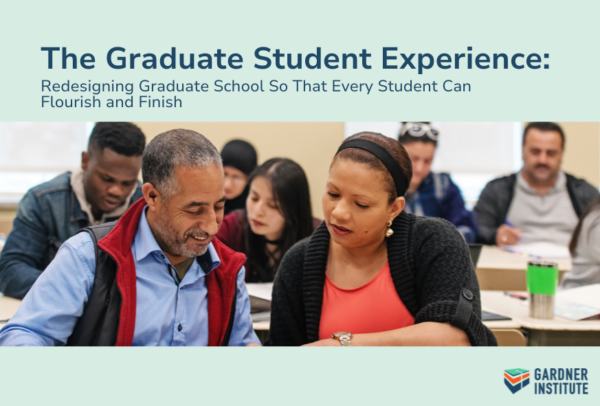
Transforming the Graduate Student Experience
Transforming the Graduate Student Experience Through Institutional Self‑Study focuses on transforming the graduate student experience system through structured institutional self‑study and evidence‑informed improvement.
This session will provide an opportunity for a guided discussion and exercises on transforming the graduate student experience. In this workshop, participants will explore current conditions affecting graduate students, learn more about what other institutions believe are the graduate student needs that are the most urgent to address, and discuss promising practices. This session will introduce the Gardner Institute’s task-force-based approach to institutional self-study, applied specifically to the graduate student experience, and will explore strategies for leading structured, collaborative inquiry. The workshop focuses on reviewing evidence, fostering collaboration across campuses, and driving improvement at the departmental or school level.
Participants will learn to:
- Facilitate collaborative conversations that support evidence-informed improvement.
- Have a deeper understanding of issues graduate students are facing that could be addressed through a self-study.
- Apply a structured self-study framework to assess the graduate student experience.
- Inform policies, practices, and culture at the departmental and institutional levels using the self-study results.
Participants will leave with:
- A draft outline for conducting an institutional self-study centered on graduate students.
- A plan for convening stakeholders and gathering meaningful evidence.
- Clear next steps to launch or enhance improvement efforts on their campus.
Leading Institutional Transformation for Student Success
Leading Institutional Transformation for Student Success focuses on transforming the leadership and alignment system that supports institution‑wide student success planning, coordination, and implementation.
This workshop supports faculty and staff who lead to institutional change efforts. Participants will explore leadership approaches aligned with the Gardner Institute’s model of student‑centered transformation. The session emphasizes building alignment across units, translating strategic priorities into actionable steps, and fostering the conditions needed for sustained change.
Participants will learn to:
- Identify effective leadership practices that support student success initiatives.
- Align institution-wide strategic goals, operational plans, and day‑to‑day work.
- Navigate common barriers to the implementation of change using evidence and campus collaboration.
Participants will leave with:
- A personal leadership action plan template to align with institutional priorities.
- Approaches for supporting cross‑departmental collaboration.
- Resources for further exploration of leadership capabilities and action planning.
Purpose-Driven Advising
Purpose‑Driven Advising: Redesigning the Advising Ecosystem focuses on transforming the advising system to strengthen how institutions guide students through educational, life, and career decision‑making and progression.
This workshop introduces participants to the Gardner Institute’s advising redesign framework and the concept of purpose‑driven advising. The session focuses on examining how advising structures, practices, and evidence can guide students as they make informed decisions aligned with their long‑term educational and career goals. Through collaborative analysis, participants will consider how institutional advising ecosystems can be strengthened using evidence, system mapping, and consistent expectations.
Participants will learn to:
- Apply the Gardner Institute’s advising redesign principles to evaluate their current advising ecosystem.
- Identify where advising structures support or hinder student progress and clarity.
- Examine examples from peer institutions to understand how purpose‑driven advising has been implemented effectively.
Participants will leave with:
- An initial roadmap outlining how purpose‑driven advising could operate on their campus.
- A list of evidence sources and stakeholders needed for an advising ecosystem self‑study.
- Clear next steps for initiating advising redesign conversations at their institution.
Transforming the Gateway Course Experience
Transforming the Gateway Course Experience focuses on transforming the gateway courses to improve outcomes in high‑enrollment, high‑impact introductory courses.
In this workshop, participants learn how to apply the Gardner Institute’s gateway course redesign model to improve high‑enrollment, high‑risk introductory courses. Participants will review evidence‑based strategies for redesigning gateway courses to increase student success and reduce DFWI rates. The session provides a structured approach for analyzing current conditions, identifying misalignments, and developing practical next steps for gateway course transformation.
Participants will learn to:
- Apply the Gardner Institute’s gateway course redesign model at their institution.
- Consider system‑level and course‑level strategies for improving student success.
Participants will leave with:
- An initial plan for strengthening a gateway course supported by evidence.
- A framework for further data inquiry and cross‑departmental collaboration.
- A set of next steps for gaining support for gateway course transformation.
Strengthening the Student‑Athlete Experience
Strengthening the Student‑Athlete Experience focuses on transforming the student‑athlete support system to strengthen academic momentum, engagement, and overall educational experience.
This workshop examines the academic and co‑curricular experience of student‑athletes, focusing on structures that support their success in and beyond the classroom. Using a system‑level lens, participants will review evidence, identify opportunities to improve coordination between academic affairs, student affairs, and athletic units, and discuss practices that deepen engagement and academic momentum for student‑athletes.
Participants will learn to:
- Examine how institutional systems shape the student‑athlete experience.
- Identify strengths and gaps in current academic and support structures.
- Consider and apply a framework that promotes deeper student‑athlete academic progress.
Participants will leave with:
- A clearer understanding of the institutional systems affecting student‑athletes.
- An initial set of improvement priorities informed by evidence.
- Next steps for engaging colleagues in strengthening student‑athlete support.
Transforming the First Year of College
Transforming the First Year of College – Foundations of Excellence focuses on transforming the first‑year experience system through structured institutional self‑study and evidence‑informed improvement.
This workshop introduces participants to the Gardner Institute’s Foundations of Excellence principles, guiding teams through a critical examination of the first‑year student experience. Participants will explore how effectively their institution supports new students, for whom the current experience works, and why. Through structured reflection, evidence review, and facilitated inquiry, teams will identify strengths and gaps across the first‑year system and develop actionable ideas for improving student transitions, engagement, and success
Participants will learn to:
- Apply the Foundations of Excellence principles to evaluate their institution’s first‑year experience.
- Examine key questions related to new‑student transitions, learning environments, and support structures.
- Interpret evidence about first‑year student outcomes to identify strengths, inequities, and areas for improvement.
- Learn from national leaders and peer institutions about proven first‑year experience strategies that can be adapted to campus context.
Participants will leave with:
- A more nuanced understanding of the current first‑year experience at their institution.
- An initial set of improvement priorities grounded in evidence and aligned with the First-Year Redesign model.
- Clear next steps for strengthening the first‑year experience and building cross‑campus alignment around new‑student success.
Using AI to Strengthen Student Success Systems
Using AI to Strengthen Student Success Systems focuses on transforming institutional systems that use AI so they align human decision‑making, academic processes, and technology in support of student success.
This workshop supports institutions exploring and experimenting with generative AI, agentic workflows, or interconnected AI systems. We will seek to build a shared understanding about appropriate use, boundaries, and purpose. This session offers a structured way to pause, learn, and align AI adoption with student success before expanding further.
The workshop is grounded in the concept of grounding intelligence, defined as the human-centered values, capacities, and decision-making structures that guide responsible AI use. Participants analyze a current or emerging AI initiative on their campus, examine how AI tools interact with people and processes, and identify opportunities to strengthen alignment with student success goals.
Participants will learn to:
- Apply the grounding intelligence framework to guide AI use in academic and student‑support contexts.
- Analyze how AI tools interact with institutional systems and workflows.
- Identify areas where human oversight and clarification are needed.
Participants will leave with:
- A structured approach for guiding AI adoption across departments.
- A system map illustrating how an AI initiative interacts with institutional processes.
- A set of next steps for improving alignment between AI tools and student success outcomes.
Pre-Conference Workshops
Teaching and Learning Community (Full Day)
The Humanity of Teaching: Cultivating Moral Imagination and Courage in the Classroom
This workshop invites participants to engage in moral imagination, the capacity to re-envision humanity within teaching, curriculum design, and institutional roles beyond the status quo. Grounded in the realities of student mental health, trauma, and educator burnout, the workshop centers humanity as a guiding principle for pedagogical practice.
Through interactive activities, case exploration, and structured reflection, participants will examine how their teaching practices can better respond to complexity with care, equity, and intentionality. The workshop also emphasizes moral courage—supporting educators in acting on their values even in challenging or uncertain contexts. By the end of the day, participants will leave with concrete strategies and a developed plan to integrate humanistic approaches into their teaching.
Workshop Learning Goals
By the end of this workshop, participants will:
- Understand how moral imagination can inform and transform teaching practices
- Recognize and respond ethically to complexity in classroom and curricular contexts
- Explore strategies to cultivate moral imagination and moral courage in students and colleagues
Workshop Outcomes
During this workshop, participants will:
- Identify 1–2 current teaching practices they will revise using principles of moral imagination
- Design a concrete learning activity that fosters student engagement with moral courage
- Develop and share a draft “humanity-centered teaching plan” (adapted from the gallery walk concept).
Note: This workshop is designed as an intensive, collaborative experience that prioritizes reflection, dialogue, and practical application. Participants will engage in individual and group activities that translate theory into actionable teaching strategies.
Grounding AI for Student Success: From Decision Points to Deliberate Action (Full Day)
How institutions frame AI shapes everything: what problems they see, whose concerns they center, what counts as success, and whether adoption is treated as inevitable or as one of several legitimate options. This pre-conference workshop gives cross-functional institutional teams the time and structure to examine a real AI initiative together, not by starting with tools, but by starting with the decision itself. Participants will explore how their institution’s orientation toward AI is shaping what choices become visible and build the shared language to engage those choices more deliberately when they return.
Working from that premise, teams will map the systems and people their decision affects, surface the governance tensions in play, and examine where feedback loops between AI tools and student success outcomes are misaligned or missing. The goal is not to arrive at any particular answer. It is to arrive at greater clarity and to return to your institution better equipped to lead the conversation.
Date: October 13, 2026
Who Should Participate
Cross-functional teams of 3 or more from the same institution, including:
- Presidents, Provosts, and Senior Administrators
- VPs or AVPs for Student Success or Academic Affairs
- Academic Deans, Department Chairs, and Directors
- Technology, data, or systems leaders
- Student success, advising, or faculty practitioners
- Policy, compliance, or governance staff
Teams are encouraged to bring people from different roles and perspectives. The cross-functional composition is what makes the mapping work meaningful.
How You’ll Benefit
- Examine how institutional orientations toward AI encode assumptions about whose problems get solved and whose do not
- Develop shared language across your team for the competing frames shaping your AI decisions
- Map how a specific AI initiative is landing across people, systems, and data, and where the gaps between intention and impact are appearing
- Name the governance tensions your institution is navigating and understand what each side is actually protecting
- Identify the next conversation your institution needs to have and leave prepared to lead it
Academic Leadership Community Launch
This session is the launch of the Academic Leadership Community. This will be the first meeting of the year-long community practice, which will meet virtually monthly from November to June.
Designed for academic leaders who directly lead faculty and academic staff, the Academic Leadership Community supports leaders in guiding transformation efforts within schools, departments, programs, and cross‑unit initiatives.
Participants build critical change‑leadership competencies, including data‑informed decision‑making, cross‑functional collaboration, and strategies for leading structural and cultural change.
Conference Registration Fees
Early Access rate (Available to the first 200 registrants): $875
Regular Registration: $950
Student Registration (graduate and undergraduate): $450
Registration Fee includes: Opening reception, two breakfasts, two lunches, refreshment breaks, and conference materials.
Registration discounts:
• Students receive a discounted registration rate.
• Registrants from Transformation schools receive 20% off posted fees.
• Returning Symposium attendees from 2023, 2024, or 2025 receive a $50 discount on posted fees.
To receive a discount code, email events@gardnerinstitute.org.
Only one discount may be applied per registration. Discounts may not be combined.
For more information, contact events@gardnerinstitute.org
Refund Policy: There will be no refunds given after August 1, 2026. All refunds will be subject to a 5% processing fee. Registration can be transferred to another participant before September 25th, no transfers will be allowed after that. Participants can switch tracks before August 1st pending availability, requests must be made in writing to events@gardnerinstitute.org.

Conference Location Information:
Hyatt Regency Indianapolis, 1 S Capitol Ave, Indianapolis, IN 46204
Room Rate $209 per night
Flights
Delta Air Lines is pleased to offer special discounts for John N. Gardner Institute for Excellence in Higher Education
You may also call Conferences and Events® at 1.800.328.1111* Monday–Friday, 8:00 a.m. – 8:00 p.m. (EST) and refer to Meeting Event Code: NY4H9
*Please note there is not a service fee for reservations booked and ticketed via our reservation
800 number.
FAQs
Who should attend the Symposium?
Administrators, faculty members, CEOs, presidents, and chancellors, Chief Academic Officers, Student Affairs, and students from institutions, systems, and higher education organizations are welcome.
What is included in the Symposium registration?
The Symposium includes all concurrent sessions during the conference. Registered participants have access to:
All sessions, including the Welcome Address, keynotes, and presentations.
The reception, all networking breakfasts, lunches, and breaks.
One workshop track, selected from the following:
- Curriculum and Transparency
- Transforming the Graduate Student Experience
- Leading Institutional Transformation for Student Success
- Purpose-Driven Advising
- Transforming the Gateway Course Experience
- Strengthening the Student‑Athlete Experience
- Transforming the First Year of College
- Using AI to Strengthen Student Success Systems
Pre-conference sessions are separate and have their own registration fees. You do not have to register for a pre-conference session to participate in the Symposium.
What are the fees for the Symposium?
Early Access rate is available to the first 200 registrants. $875
Regular Registration: $950
Student Registration (graduate and undergraduate): $450
When will the schedule be released?
The full conference program is shared in stages, with the final program released in September. Be sure you’re subscribed to our email interest list to be notified when it’s available.
Are any sessions offered virtually?
All sessions during the conference take place in person. The Gardner Institute offers virtual engagements and services throughout the year.
Who can attend pre-conference sessions?
There are several preconference workshops and launches for the Symposium that will occur on October 13, before the Symposium begins. See more information about each session, including topics, who is invited to register, fees, and more. Pre-conference sessions are available as a separate option. You do not need to register for the full Symposium to attend a pre-conference session.
How can I change, transfer, or cancel my registration?
There will be no refunds given after August 1, 2026. All refunds will be subject to a 5% processing fee. Registration can be transferred to another participant before September 25th, no transfers will be allowed after that. Participants can switch tracks before August 1st pending availability, requests must be made in writing to events@gardnerinstitute.org.
How do I book a hotel for the Symposium?
The reserved room block is at the same location as the Symposium: Hyatt Regency Indianapolis. Located at 1 S Capitol Ave, Indianapolis, IN 46204.
Room Rate $209 per night. Book hotel here
Do I need to register for individual sessions?
When registering for the Symposium, you will be required to select your workshop track. You do not need to register for the concurrent sessions you will attend during the Symposium.
What forms of payment are accepted?
Payment is accepted in the form of credit card, invoice, or bank transfer.
Who do I contact if I have questions about payment?
Please contact events@gardnerinstitute.org.
Does the Symposium provide assistance for persons with disabilities?
Yes, the Gardner Institute is committed to making all reasonable accommodations that will allow attendees to fully participate in the Symposium. Please indicate any accommodations during registration, or contact us at events@gardnerinstitute.org.
What should I wear to the Symposium?
We recommend wearing business casual attire and comfortable shoes. Additionally, please dress in layers to accommodate temperature variations in the event spaces.
Are printed handouts available for sessions?
All conference materials will be available on the conference mobile app and sent to registered participants by email. Printed handouts will not be available at the conference. If you would like to have printed materials for a certain session, we recommend printing copies to bring with you.
Who do I contact if my question isn’t answered on the website?
For questions related to the Symposium, please contact events@gardnerinstitute.org.